Tel/Fax: +44 (0)116 291 6019 Mob: +44 (0)790 397 7402
Email: solopiper@hotmail.co.uk
Wedding's
Funeral's
Burns Night's
New Year's Eve
Corporate Events
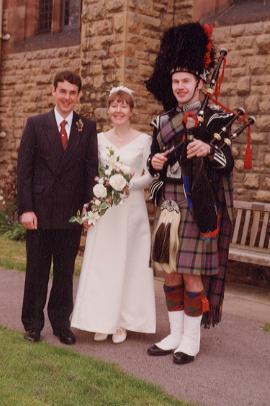
Weddings
A time of joy and happiness
There are many variations of how to have piper be part of your big day,
At the Church/Registry Office:-
- play purely as guests arrive and/or leave,
- play the bride up the aisle (processional),
- play as the register is being signed,
- play at a point in ceremony to mark respect to dearly departed,
- pipe the bride & groom down the aisle (recessional)
- pipe as photographs are being taken
- as bride & groom leave
At the Reception:-
- play as the Bride & Groom arrive,
- play at receiving line,
- pipe top table in (excluding bride & groom)
- pipe bride & groom in to top table
Music
Examples of tunes:-
- Mharies Wedding
- Scotland the Brave
- Highland Cathredral
- My Home
- Wagners Bridal Chorus
If you have any particular tune in mind just ask i will do my very best
to accomodate it.
Links Info
www.cofe.anglican.org/worship
http://www.youandyourwedding.co.uk
http://www.ultimatebridal.co.uk
| Church of England Wedding service |
|
Beginning the service
|
|
Traditionally, the bride and groom enter the church separately -
the groom first with the best man, and the bride at the time set
for the start of the service, on the arm of her father or
another relative or friend (it does not need to be a man).
However, the bride may enter alone if she wishes, or the couple
may enter together.
The minister will welcome the congregation. Your family and friends have an important role to play as witnesses and supporters of your marriage. The minister will read an introduction explaining what Christians believe about marriage. He or she will also ask, as the law requires, if anyone knows any reason why the marriage may not lawfully take place. |
| Declarations |
| You will be asked to promise before God, your friends and your
families, that you will love, comfort, honour and protect your partner
and be faithful to them as long as you both shall live. The minister will also ask the congregation to declare that they will support and uphold your marriage. |
| Vows |
| Turning to each other, the bride and groom take each other’s right
hand and make vows: 'to have and to hold |
| Rings |
| The couple then exchange a ring or rings as a 'sign of their
marriage' and a reminder of the vows: 'With my body I honour you, |
| Proclamation |
| The minister will then declare that you are now husband and wife. The minister does not 'marry you'; you marry each other. The minister just directs you in this and then tells everyone that you have done it properly. |
| Prayers |
| In the prayers God’s blessing and help is asked for you. There may be a prayer for the gift of children, but every couple will have their own feelings about this, so it's best to discuss the details with your minister. You may wish to help choose the prayers or to write your own. |
| Readings and talk or sermon |
| It is usual to have one or more readings (one of which should be from the Bible) and the minister will generally give a talk or sermon. |
| Signing of the register |
| After you have exchanged your vows, the bride, groom and two
witnesses must sign the register. This is a legal requirement and the
minister will give you a copy of the marriage certificate.
|
© 1982 - , John McFadden