Tel/Fax: +44 (0)116 291 6019 Mob: +44 (0)790 397 7402
Email: solopiper@hotmail.co.uk
Wedding's
Funeral's
Burns Night's
New Year's Eve
Corporate Events
|
|
|
|
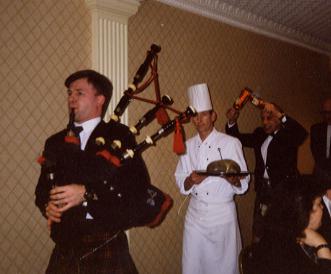
John piping the haggis in |
The Burns Supper
The Burns Supper is an institution of Scottish life, a night to celebrate the life and genius of the national Bard. Suppers can be everything from an informal gathering of friends to a huge, formal dinner full of pomp and circumstance. This running order covers all the key elements you need to plan and structure a Burns Supper that suits your intentions.
The running order for a traditional Burns Supper
Piping in the guests
A big-time Burns Night calls for a piper to welcome guests. If you don't want all that baggage, some traditional music will do nicely. For more formal events, the audience should stand to welcome arriving guests: the piper plays until the High Table is ready to be seated, at which point a round of applause is due.
Chairman's welcome
The Chairman warmly welcomes the assembled guests.
The Selkirk Grace
A short but important prayer to usher in the meal with a reading of
The Selkirk Grace.
Piping in the Haggis
Guests should normally stand to welcome the dinner's star attraction, which should be delivered on a silver platter by a procession consisting of the chef, the piper and the person who will address the Haggis. A whisky-bearer should also arrive to ensure the toasts are well lubricated.
During the procession, guests clap in time to the music until the Haggis reaches its destination at the table. The music stops and everyone is seated in anticipation of the address "To a Haggis".
Address to the Haggis
The honoured reader now seizes their moment of glory by offering a fluent and entertaining rendition of "To a Haggis". The reader should have their knife poised at the ready. On cue ("His knife see Rustic-labour dight"), they cut the casing along its length, making sure to spill out some of the tasty gore within ("trenching its gushing entrails").
Warning: it is wise to have a small cut made in the haggis skin before it is piped in. Instances are recorded of top table guests being scalded by flying pieces of haggis when enthusiastic reciters omitted this precaution!
The recital ends with the reader raising the Haggis in triumph during the final line ("Gie her a Haggis!"), which the audience greets with rapturous applause.
Toast to the Haggis
Prompted by the speaker, the audience now joins in the toast to the Haggis. Raise a glass and shout: "The Haggis!" Then it's time to serve the main course with its traditional companions, neeps and tatties. In larger events, the piper leads a procession carrying the opened Haggis out to the kitchen for serving; audience members should clap as the procession departs.
The meal
Dinner is served with some suitable background music. The sumptuous Bill o' Fare includes traditional cock-a-leekie soup before the main course ("Haggis wi' bashit neeps an' champit tatties"), followed by a sweets course of "clootie dumplin" (a pudding prepared in a linen cloth or cloot) or "Typsy Laird" (a Scottish sherry trifle).
Afterwards comes the cheese board, served with bannocks (traditional oat-cakes) and tea/coffee/malt whisky.
Variations do exist: beef lovers can serve the haggis, neeps and tatties as a starter with roast beef or steak pie as the main dish. Vegetarians can of course choose vegetarian haggis, while vegaquarians could opt for a seafood main course such as Cullen Skink.
The drink
Liberal lashings of wine or ale should be served with dinner and it's often customary to douse the Haggis with a "wee splash of whisky sauce", which, with true Scottish understatement, is whisky neat.
After the meal, it's time for connoisseurs to compare notes on the wonderful selection of malts served by the generous host.
The first entertainment
The nervous first entertainer follows immediately after the meal. Often it will be a singer or musician performing Burns songs such as "My Luve is Like a Red Red Rose", "Rantin', Rovin' Robin", "John Anderson, my jo" or "Ae Fond Kiss, and Then We Sever". Alternatively it could be a moving recital of a Burns poem, with perennial preference for "Tam O'Shanter", "Holly Willie's Prayer", "To a Louse", "Address to the Unco Guid" or "For a' that and a' that".
The Immortal Memory
The keynote speaker takes the stage to deliver a spell-binding oratory on the life of Robert Burns. His literary genius, his politics, his highs and lows, his human frailty and - most importantly - his nationalism are the enduring themes. The speech must bridge the dangerous chasm between serious intent and sparkling wit, painting a colourful picture of Scotland's beloved Bard.
The speaker concludes with a heart-felt toast: "To the Immortal Memory of Robert Burns!"
The second entertainment
More celebration of Burns' work, preferably a poem or song to complement the earlier entertainment.
The toast to the Lassies
The humorous highlight of any Burns Night comes in this toast, which is designed to praise the role of women in the world today. This should be done by selective quotation from Burns's works and should crescendo towards a positive note.
The toast concludes: "To the Lassies!"
The third entertainment
Further indulgence in the works of the great man.
The reply to the toast to the Lassies
In mixed proceedings, a woman has the right of reply to the men's toast. Thanking the toast-master for his kind words is a necessary - and some times strained - formality, but the response offers the chance to upstage the men, again through cunning use of examples from Burns's life and works.
Final entertainment
As the last drops of malt are drained, a final entertainer bravely faces the (usually restless) audience.
Vote of thanks
The host now climbs to his potentially unsteady feet to thank everyone who has contributed to a wonderful evening… and to suggest that taxis will arrive shortly.
Auld Lang Syne
The chairman closes the proceedings by inviting guests to stand and belt out a rousing rendition of the famous tune. The company joins hands and sings as one, having made sure to brush up on those difficult later lines.
© 1982 - , John McFadden